The Coach Pickle Drill Library: 58 Pickleball Drills from 2.5 to 5.0+
Coach Pickle now ships a curated library of 58 step-by-step pickleball drills, organized by DUPR skill level. Dinks, drives, drops, volleys, serves, returns, movement, strategy, and more — with mechanics, drill-flow targets, and AI video analysis on top.
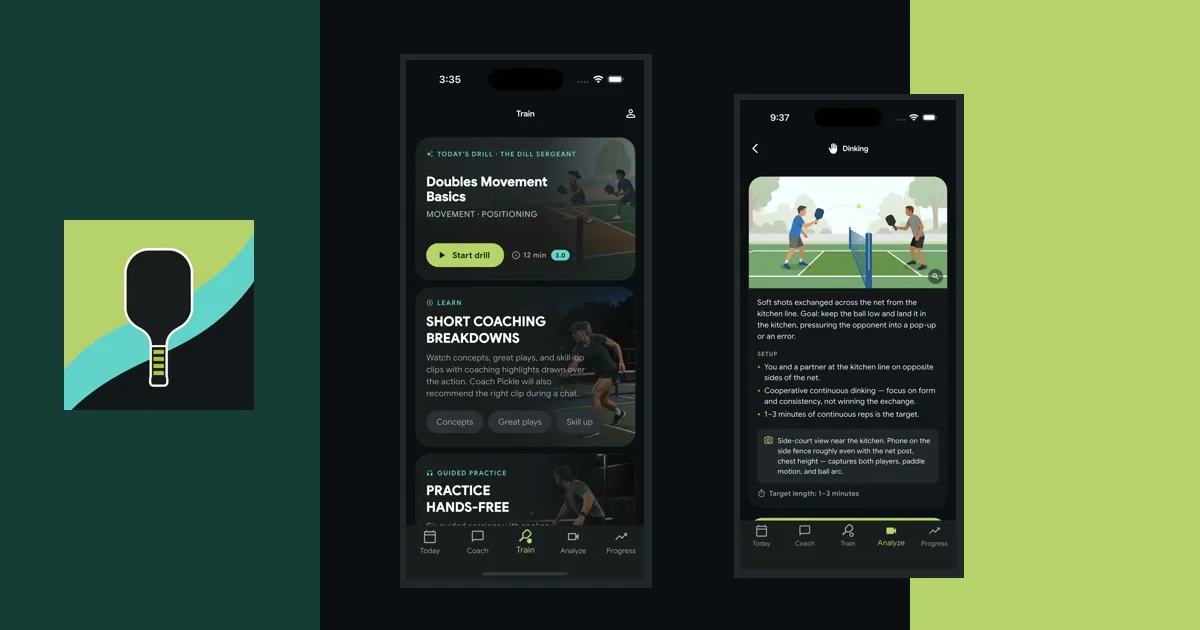
Coach Pickle now includes a curated drill library — 58 pickleball drills, organized by DUPR skill level from 2.5 (true beginner) all the way to 5.0+ (elite hands-battles). Every drill is fully authored: a hero illustration, a multi-step mechanical breakdown, a drill-flow card with restart and switch rules, a measurable goal, and intro voiceovers from each of the eight Coach Pickle personalities. Open the app, tap any drill, and you have a complete practice plan you can run today.
This is the second half of how the app teaches pickleball. The first half — AI drill video analysis — already lets you record reps and get a rep-by-rep technique breakdown from your phone. The drill library is what tells you what to drill in the first place — the routine the AI then has something to evaluate against. Together they close the loop: pick a drill, run reps, record a clip, get fixes, get a recommended next drill, run it again. Below is what’s in the library, why each drill exists, and how to find the ones that fit your level.
Why a curated drill library matters
Most improving players know they should drill more than they play. The problem is everything underneath that: which drill, for which weakness, at which level, with which equipment? “Just go dink for an hour” is the kind of advice that sounds correct but produces aimless reps. The Coach Pickle drill library answers the harder questions — which dinking drill, what the goal is, how many reps before you switch, what to do when the rally falls apart, and why this particular pattern matters for the level you’re at.
Every drill in the library was authored to be specific in three ways. It targets a known weakness at the level it’s filed under. It has a measurable goal — not “do it for ten minutes” but “twenty in-zone reps in a row” or “60% of attempts land soft in the kitchen.” And it knows when to restart — pop-up, foot fault, missed read — so the rep counter actually means something. That structure is what turns a court session into deliberate practice instead of a free-form rally.
How the library is organized
The 58 drills are filed along three axes you can mix and match in the app:
- By DUPR skill level — six bands from 2.5 to 5.0+. Levels 2.5 through 4.5 each have 10 drills; 5.0+ has 8 advanced drills.
- By shot family — dinks, drives, drops, and volleys. Pick a wing you want to work on; the library has drills across every level for it.
- By setup — partner, ball machine, wall, or solo. Open the filter, pick what equipment you have today, and the library shows you only drills that match.
The combinations matter because most players don’t have unlimited resources. A 3.0 player with a wall and ten minutes has different options than a 4.0 player with a partner and an hour. The library is built to give you something useful in either case.
What every drill includes
Every drill in the library is built from the same authored components, designed to be run end-to-end in a single court session:
- Hero illustration — a clear visual of the drill setup, court positions, and ball path so you know what you’re doing before you start.
- Two-sentence purpose — what the drill builds and why it matters at your level.
- Coach voice intro — your selected coach personality (Sergeant, Chill, Coach Pro, Strategist, Zen, Hype, Rally, or Coach Pickle himself) gives you a tonally-distinct framing for the same drill. Same mechanics, different motivation. Pick the voice that gets you off the couch.
- Drill flow card — setup, sequence (rally pattern A → B → C → D), restart rule (what counts as a failed rep), switch rule (when to swap sides or partners), and a measurable goal.
- Five mechanical steps — each with a short summary, an illustrated breakdown, and 3–4 bullet cues you can hold in your head during reps (stance, grip, contact, follow-through, recovery — adapted to the shot).
- Closing CTA — the next move when you’re done. Save the drill to favourites, drop it into a workout, or queue up the AI video analysis to see how your reps actually looked.
The result is a drill that runs itself. You don’t need a coach standing on the other side of the net telling you what to do next — the structure is in the drill.
The drills, by skill level
Below are representative drills from each DUPR band. The in-app library contains all 58; pick the level that matches yours, then filter by shot family or setup to find the right assignment.
2.5 — Beginner Fundamentals
This is where the paddle stops feeling foreign. The 2.5 drills isolate single mechanics — contact point, follow-through, soft hands — so the body learns one thing at a time before any rally pressure shows up.
Forehand Groundstroke Reps
The forehand drive is the bread-and-butter of every baseline rally. Drill the contact point and follow-through until they’re automatic — every rally from the back of the court starts here. Goal: fifty in-zone forehand drives in a row before stopping. 15 min · ball machine.
Backhand Groundstroke Reps
The backhand is where rallies are won and lost at every level. Drill the contact point in front of the body and the through-the-target follow-through until the wing stops being a weakness. Goal: fifty in-zone backhand drives in a row. 15 min · ball machine.
Self-Feed Dink Contact
Before you can rally, you have to feel the ball on the paddle. Bounce-tap dinks straight up off your own paddle to learn soft contact — no opponent, no pressure, just the touch. Goal: thirty controlled vertical taps in a row on each face. 8 min · solo.
Volley Wall Tap
A wall and a paddle is all you need to learn volleys. Tap the ball into the wall continuously without letting it bounce — builds the compact contact and quiet hands every kitchen exchange demands. Goal: twenty consecutive volleys per face without a ground bounce. 10 min · wall.
Drop & Step Forward
A drop you don’t follow is a drop wasted. Pair every soft drop with two steps forward — that’s how beginners learn to advance to the kitchen as a unit, not get caught marooned in no-man’s-land. Goal: ten drop-and-step rounds where every drop lands soft in the kitchen and the player commits to two steps forward. 10 min · partner.
3.0 — Foundational Strategy
At 3.0 the basic mechanics work, but the patterns don’t yet. These drills drill the patterns: deep returns, third-shot drops into the kitchen, cross-court dink rallies, full-rally volley pairs.
Deep Drive Targets
Drives that don’t reach the back third are sitters waiting to happen. Hit specific deep targets — corners, centre, off-pace mid — until depth is the default, not the exception. Goal: 75% in-zone over 50 reps in the random phase. 12 min · ball machine.
Cross-Court Dinks
Cross-court dinks travel over the lowest part of the net and the longest distance available — geometry built for soft, patient rallies. Hit them at every length until the angle stops feeling foreign. Goal: 25-shot rally floor with zero pop-ups, on each diagonal. 10 min · partner.
Wall Drives
A wall is the cheapest practice partner you’ll ever have for groundstroke reps. Drive forehand and backhand drives off the wall continuously — the bounce-pace combo is unforgiving and the rep volume is unbeatable. Goal: thirty in-zone drives per face at chest-height contact. 18 min · wall.
Forehand-Backhand Volley Pairs
Real rallies don’t give you the same wing twice in a row. Drill alternating forehand-backhand wall volleys until switching wings is automatic — same grip, different paddle face, no thought. Goal: twenty strict alternations in a row, then thirty random-side responses. 10 min · wall.
Third Shot Drop
The third shot drop is the bridge from baseline to kitchen. Hit it soft, land it in the kitchen, and pair every drop with two steps forward — the single most important shot in transition pickleball. Goal: 60% of drops land soft in the kitchen across all 75 reps. Read more in our third shot drop deep-dive. 20 min · ball machine.
Wall Dink Touch
A wall is a forgiving partner for dink-touch reps. Tap softly into the wall at low height, let the bounce return, and dink again. Builds the soft hands you’ll need at the kitchen — solo, fast, controlled. Goal: twenty consecutive low dinks per face. 10 min · wall.
3.5 — Intermediate Tactics
3.5 is where rec-night players cross into “real” pickleball. These drills drill the patterns that stop feeling new and start feeling like the defaults: cross-court dinks until they’re automatic, deep drives, reset volleys, return-and-rush.
Dink to Death
The most important drill in high-level pickleball. You’ll hit cross-court dinks until it’s automatic — over the lowest part of the net, the longest distance available. Goal: 20-shot rally floor — not the ceiling. Build to fifty shots without an unforced pop-up. 15 min · partner.
Baseline Drives
A baseline drive is the third-shot alternative when the drop isn’t the right call. Fast, deep, low — and aimed at the opponent’s feet. Drill the controlled drive that pressures without surrendering position. Goal: 50% in-zone (at the feet, just past the kitchen) over 75 reps. 12 min · ball machine.
Reset Volleys
Caught in the transition zone with a hot ball coming? Don’t try to win the rally — reset it. A reset volley is a soft block into the kitchen that buys you time and turns defence into a stalemate. Goal: 70% of resets land soft inside the partner’s kitchen. 12 min · partner.
Return & Rush
The return is your only free trip to the kitchen. Hit it deep, then sprint forward — no exceptions. Drill the deep return paired with the four-step rush until reaching the kitchen on every return is automatic. Goal: 80% of returns land in the back third and the player is at the kitchen line before the partner’s third shot bounces. 15 min · partner.
Triangle Dinks
Cross-court, middle, line — three targets that force your opponent to move while you stay anchored. Build the precision and patience to dictate the soft game before any speed-up arrives. Goal: build to a 50-shot triangle rally with zero pop-ups. 12 min · partner.
Transition Zone Drops
The trickiest spot on the court is the transition zone — too far to volley, too close to drive. Drill the soft drop from mid-court that lets you keep advancing instead of getting pinned. Goal: 2–3 transition drops to reach the kitchen per round, 80% landing soft. 12 min · partner.
Backhand Third Shot Drops
Most teams hunt your backhand on the third shot — that’s exactly why it has to drop reliably. Drill the soft backhand drop until the wing your opponents target stops giving them free attacks. Goal: 60% in-zone soft backhand drops over 75 reps. 15 min · ball machine.
4.0 — Building Pressure
At 4.0 dinking and dropping are no longer the test — creating attacks is. These drills drill the pressure shots: speed-ups from the dink, body-bag volleys, Erne setups, attacking the backhand wing.
Speedup from the Dink
A clean speedup wins more dink rallies than another patient dink. Drill the moment-to-attack — high contact, body-bag target, paddle face redirected — and own the transitions from soft game to hands battle. Goal: 50% of speedups land at the body-bag zone and result in a winner or forced error within two shots. 12 min · partner.
Body-Bag Volleys
When you get a high ball at the kitchen, the dominant hip is the only target that matters. Drill the body-bag volley until aiming there is automatic — even when the rally pace is high. Goal: 70% of body-bag volleys hit the target zone. The aim is hip — never face, never feet, never centre of the body. 10 min · ball machine.
Erne Setup
The Erne is the most dramatic volley in pickleball — leap around the kitchen sideline to volley a cross-court dink mid-flight. Done well, it’s a winner. Done poorly, it’s a foot-fault. Drill the read and the leap. Goal: 60% of identified Erne opportunities convert to a clean volley at the hip without foot-faulting. 15 min · partner.
Attack the Backhand
Most opponents are weakest on the backhand wing. Drill the patterns that hunt that wing — deep returns, off-bounce drives, third-shot drives — until pinning their backhand is the default plan. Goal: 70% in-zone over 75 reps. 12 min · ball machine.
Block & Reset Volleys
When the opponent attacks a high ball at the kitchen, the right answer isn’t always a counter. Drill the block-into-the-kitchen — soft hands, dead drop, neutralised attack — for when the counter isn’t on. Goal: 75% of blocks land soft inside the partner’s kitchen. 12 min · partner.
Defensive Drop Reset
Driven hard from the baseline? Don’t drive back. Drop. The defensive drop is the soft answer to a fast attack — converts a desperate position into a stalemate, kitchen-bound on the next ball. Goal: 70% of defensive drops land soft in the partner’s kitchen. 12 min · partner.
Reaction Wall Volleys
A wall returns whatever pace you give it — perfect for hands-battle reps. Stand close, hit hard, react harder. Twenty-five fast wall volleys per session builds the reaction time you need at the kitchen. Goal: twenty-five consecutive fast wall volleys per phase. 10 min · wall.
4.5 — Counter Game
At 4.5 dinks aren’t soft any more — they’re probes setting up speed-ups two shots later. These drills drill the counter game: counter-attack volleys, roll volleys, ATP setups, multi-move chess-match dink patterns.
Counter-Attack Volleys
Most rallies end on the first speed-up. Drill the reflexive block-counter at the kitchen until it’s reactive, not deliberative — and flip every attack into your point. Goal: 70% of counters cleanly land in the opposing player’s hip zone. Aim for five minutes of continuous hands-battle per rotation. 12 min · partner.
Roll Volley Attack
A roll volley adds topspin to a volley — diving the ball into the opponent’s feet at speed. The 4.5 weapon for high balls when the body-bag isn’t enough. Drill the brush-up motion until the spin is automatic. Goal: 60% in-zone over 75 reps. 12 min · partner.
ATP (Around the Post) Setup
The ATP — Around the Post — is the most legal and most stylish winner in pickleball. Drill the read on a wide cross-court dink so you recognise the ATP setup before it happens, then attack the open court around the post. Goal: 70% of identified ATP opportunities convert to a winner around the post. 12 min · partner.
Chess-Match Dinks
At 4.5, the dink rally is a chess match. Each shot positions you for the next attack two or three moves later. Drill the patterns — short, deep, body, line — that build to the speed-up they can’t defend. Goal: 70% of patterns leave the partner reaching by shot three and a clean shot-four finish. 15 min · partner.
Topspin Roll Drop
A topspin roll drop is the modern third-shot drop — soft enough to land in the kitchen, but with enough spin to dive sharply at your opponent’s feet. Drill the brush motion until the spin is automatic. Goal: 60% in-zone topspin drops over 75 reps. 12 min · partner.
5.0+ — Elite
At 5.0+ the rally is often decided by reflex under pressure. The advanced library covers those fast, tactical situations; Hands Battle Speedups is one of its defining drills.
Hands Battle Speedups
At 5.0+, kitchen rallies turn into hands battles in a heartbeat. Drill the speed-up + counter + counter-counter sequence until your hands operate ahead of your mind. The level where the rally is won by reflex, not strategy. Goal: 5+ shot hands battles at least 50% of the time. 15 min · partner.
Drilling solo, partner, ball machine, or wall — pick by what you have
The library is searchable by setup so you never open the app and find that today’s options need equipment you don’t have. The 58 drills span four practical setups:
- Solo — Self-feed touch, shadow movement, serving, and other repetitions where you and a paddle are the entire setup.
- Wall drills — Volley Wall Tap, Wall Drives, Forehand-Backhand Volley Pairs, Wall Dink Touch, Reaction Wall Volleys, and other high-volume options. Wall drills are the quiet superpower: cheap, available, and unforgiving in a way a partner can’t be.
- Ball-machine drills — Forehand/Backhand Groundstroke Reps, Deep Drive Targets, Third Shot Drop, Baseline Drives, Backhand Third Shot Drops, Body-Bag Volleys, and other repeatable feeds. The machine throws the same ball every time — perfect for grooving a swing.
- Partner drills (most of the library) — anything that requires a live read: Cross-Court Dinks, Triangle Dinks, Reset Volleys, Erne Setup, ATP Setup, Chess-Match Dinks, Counter-Attack Volleys, Hands Battle Speedups. Partner drills are where the decision-making lives, which is why they dominate the upper levels.
The takeaway: you don’t need a coach, a partner, or a ball machine to drill every day. You need one of them, and the library shows you which drills match.
Drills + AI video analysis: the loop that closes
A drill library is half the puzzle. The other half is knowing whether your reps actually look like the drill says they should. That’s what Coach Pickle’s AI drill video analysis is for. Once you’ve finished a drill, prop your phone up, hit the same skill for 1–3 minutes, and the app gives you a rep-by-rep technique breakdown: an overall rating, per-component scores (stance, grip, contact, follow-through, footwork), strengths tied to specific reps, and prioritized fixes for next session.
The output ends with a recommended next drill — pulled from the same 58-drill library you just ran from. Did the AI flag your contact point as the limiter? Your next session is queued. Did it spot inconsistent depth on your drives? There’s a deep-target drill waiting for you.
That’s the loop: drill → record → review → next drill → repeat. The library tells you what to practice; the AI tells you whether you practiced it well; the recommendation tells you what to practice next. You stop guessing what to do on the court — and you stop guessing whether what you did worked.
How to start
Open the Coach Pickle app, tap the Drills tab, and you’ll land on the full library. Filter by skill level, shot family, or setup until you find a drill that fits today. Tap any card to open the full walk-through:
- The hero illustration shows you the setup at a glance.
- Your selected coach gives you the intro voice-over (change coaches in your profile any time).
- The drill flow card lays out setup → sequence → restart rule → switch rule → goal.
- The five mechanical steps walk you through stance, grip, contact, follow-through, and recovery — with an illustrated cue for each.
- When you’re done, save the drill to favourites, slot it into a workout plan, or queue an AI video review.
If you’re not sure where to start, our beginner drill guide is a good warm-up before opening the library, and our third shot drop guide and dinking strategy post pair perfectly with the 3.0 and 3.5 sections above.
Coach Pickle starts with a free 7-day trial on the App Store and Google Play, then continues as one $49-per-year membership unless you cancel before the trial ends. The membership includes all 8 coaches, the full 58-drill library, and AI video analysis. Open the app, pick your level, and run your first drill today.
Want Personalized Coaching?
Coach Pickle gives you an AI pickleball coach in your pocket. Get strategy advice, drills, and mental game coaching tailored to your skill level.