Pickleball Stacking: A Complete Guide
Learn pickleball stacking strategy for doubles. Covers full stacking, half stacking, when to stack, positioning, transitions, and common mistakes.
Pickleball Stacking: A Complete Guide
If you have watched competitive pickleball doubles, you have probably noticed something that looks odd at first: both players standing on the same side of the court before a serve or return. This is stacking, and it is one of the most effective advanced formations in doubles pickleball.
Stacking allows you and your partner to control which side of the court each of you plays on, regardless of who is serving or receiving. Once you understand the mechanics and the reasons behind it, stacking becomes a powerful tool for optimizing your team’s strengths.
What Is Stacking?
In standard doubles pickleball, your court position is determined by the score. When the score is even, the server is on the right side. When it is odd, the server is on the left. This means you and your partner constantly switch sides throughout the game.
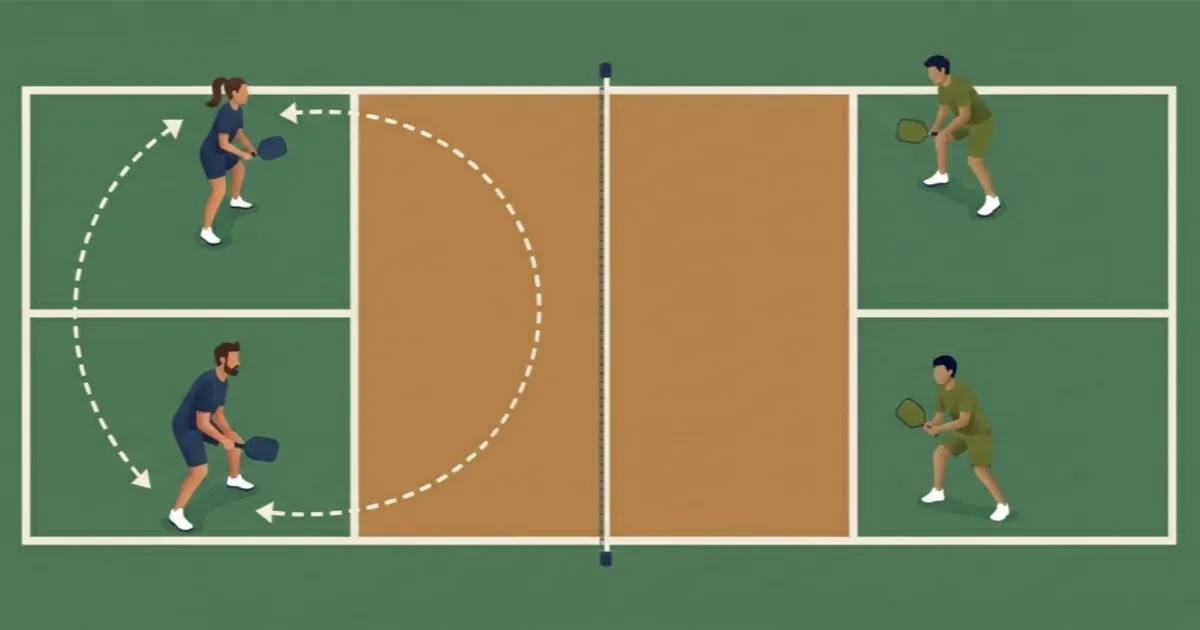
Stacking overrides this default by having both players line up on the same side of the court, then sliding into their preferred positions after the serve or return. The result is that one player consistently plays the left side and the other consistently plays the right, no matter what the score dictates.
Why Stack? The Strategic Advantages
There are several compelling reasons to incorporate stacking into your doubles game.
Keep Forehands in the Middle
The most common reason for stacking is to keep both players’ forehands covering the middle of the court. In a standard right-handed pairing, when both players are at the kitchen line, the middle is covered by backhands. By stacking so that one player is always on their preferred side, you ensure forehands dominate the middle where most attacks happen.
This is especially valuable when:
- One or both players have a significantly stronger forehand than backhand
- You are facing opponents who consistently target the middle
Optimize for a Lefty-Righty Pairing
If your team has one left-handed player and one right-handed player, stacking is almost essential. The natural formation puts both forehands in the middle, creating a wall of offense that is extremely difficult to attack through. Without stacking, the standard rotation may put both backhands in the middle, which is a major disadvantage.
Create Favorable Matchups
Stacking lets you choose which player faces which opponent. If your partner matches up well against a particular opponent, say a player who always attacks down the line, stacking ensures that matchup stays consistent.
Protect a Weaker Side
If one player has a vulnerable backhand or struggles with a particular type of attack, stacking keeps them on the side where that weakness is less exposed.
Full Stacking: How It Works
Full stacking means you stack on every serve and every return, regardless of score. Here is the step-by-step mechanics.
When Your Team Is Serving
- Both players start on the same side of the court. The server stands in the correct serving position (determined by score), and the partner stands next to them, usually just outside the sideline or slightly behind.
- The server delivers the serve.
- Immediately after the serve, the non-serving partner slides across to their preferred side of the court.
- The server stays on their side or adjusts position as needed.
When Your Team Is Returning
- The receiver stands in the correct return position (determined by the score). The partner stands on the same side, typically near the kitchen line but out of the way.
- The receiver makes the return.
- As the receiver moves forward toward the kitchen line, the partner slides over to their preferred side.
- Both players arrive at the kitchen line on their chosen sides.
The Key Principle
The non-hitting player is the one who moves. While your partner is making the serve or return, you are sliding across the court to get into position. Timing is everything. You need to be in position before the next ball arrives.
Half Stacking: A Simpler Alternative
Full stacking on every point can be physically demanding and complex. Half stacking is a more accessible option that gives you many of the same benefits.
With half stacking, you only stack when the standard rotation would put you on the wrong side. When the score naturally places you on your preferred side, you play standard formation. When it does not, you stack.
Advantages of Half Stacking
- Less movement. You only slide when necessary, conserving energy.
- Easier to learn. Players new to stacking can start with half stacking and progress to full stacking as they get comfortable.
- Less confusion. There are fewer transitions to manage, which means fewer positioning errors.
When to Choose Full vs. Half Stacking
| Factor | Full Stacking | Half Stacking |
|---|---|---|
| Lefty-righty team | Strongly recommended | Works well |
| Both players right-handed | Useful if one side is much stronger | Good starting point |
| Fitness level | Requires more lateral movement | Less demanding |
| Experience with stacking | For practiced teams | For teams learning stacking |
| Opponent pressure | Better consistency | May have transition gaps |
When Should You Stack?
Stacking is not always the right choice. Consider using it when:
- You have a lefty-righty combination. This is the most clear-cut case for stacking.
- One player has a dominant forehand. Keeping that forehand in the middle is worth the extra movement.
- Your opponents attack the middle. Stacking with forehands in the middle neutralizes this strategy.
- You want specific matchups. If one of you matches up better against a particular opponent, stacking keeps that alignment.
Consider not stacking when:
- Both players are comfortable on either side and have strong backhands
- You and your partner have not practiced stacking together
- The extra movement is causing positioning errors that outweigh the benefits
Communication Is Everything
Stacking falls apart without clear communication between partners. Before the match and during play, you need to be on the same page about several things.
Before the Match
- Agree on whether you are full stacking or half stacking
- Decide who plays which side
- Establish verbal or non-verbal signals for any in-match adjustments
During Play
- Call the slide. The moving player should say “sliding” or “going” so their partner knows the transition is happening.
- Confirm position. A quick “I’m here” or a paddle tap lets your partner know you are set.
- Signal changes. If you decide to stop stacking for a few points (maybe to rest or adjust to a specific opponent tactic), communicate that clearly.
Hand signals behind the back are commonly used in competitive play, especially for signaling poach attempts or formation changes. Develop a simple system with your partner and use it consistently.
The Transition: Where Stacking Breaks Down
The most vulnerable moment in stacking is the transition, the few seconds while the non-hitting player slides to their side. If the opponents hit the ball to the vacated area during this window, you can get caught out of position.
Tips for Clean Transitions
- Start moving early. Begin your slide as soon as your partner makes contact, not after.
- Stay low. Slide with your knees bent and paddle up so you are ready to play a ball if it comes to you mid-transition.
- Use short, quick steps. Long strides make it harder to stop and react if the ball comes your way.
- Practice the timing. The slide should feel automatic. Drill it until you do not have to think about when to move.
Protecting the Gap
The server or returner can help protect the transition gap by:
- Placing the serve or return deep, buying time for the slide
- Angling the return cross-court to pull opponents away from the vulnerable area
- Being ready to cover the middle temporarily until the partner is in position
Common Stacking Mistakes
Even experienced teams make these errors when stacking. Watch out for:
1. Moving Too Late
The most common mistake. If you wait to see where the third shot is going before sliding, you will be caught in no-man’s land. Commit to the slide early.
2. Forgetting to Stack on Specific Scores
In half stacking, it is easy to lose track of which scores require stacking and which do not. Develop a mental checklist or have your partner remind you.
3. Poor Serve or Return Placement When Stacking
When stacking, your serve or return needs to be solid enough to give your partner time to transition. A short return that your opponent can attack quickly leaves you both scrambling.
4. Neglecting the Non-Kitchen-Line Transition
Stacking is most discussed in the context of the kitchen line, but you also need to manage positioning when one or both players are still in the back court. Make sure you understand where each player should be in every phase of the point.
5. Over-Stacking
Some teams stack when they do not need to. If you are already on your preferred side based on the score, just play standard. Unnecessary stacking adds complexity without benefit.
Practicing Stacking With Your Partner
To make stacking second nature, dedicate practice time specifically to the formation.
- Shadow drill. Practice the slide without a ball. One player mimics a serve or return while the other practices the slide, timing the movement with the swing.
- Serve and slide. Hit actual serves while the partner practices sliding into position. Focus on timing, not rally play.
- Return and transition. Practice returns with the partner sliding from the same side to their preferred position, then play out the point.
- Full-point play. Once the basics are comfortable, play full points using stacking and evaluate after each point whether the positioning was correct.
How Coach Pickle Can Help
Learning stacking from written descriptions only goes so far. Coach Pickle can walk you through stacking scenarios interactively, help you understand when stacking makes sense for your specific partnership, and reinforce proper positioning through personalized coaching. If you are also working on reading your opponents and making tactical adjustments, adding stacking to your toolkit gives you another layer of strategic control in doubles play.

Want Personalized Coaching?
Coach Pickle gives you an AI pickleball coach in your pocket. Get strategy advice, drills, and mental game coaching tailored to your skill level.