Pickleball Rules for Beginners: A Fun, Easy Guide
Learn the basic pickleball rules in minutes, including serving, scoring, the two-bounce rule, the kitchen, faults, and doubles rotation.
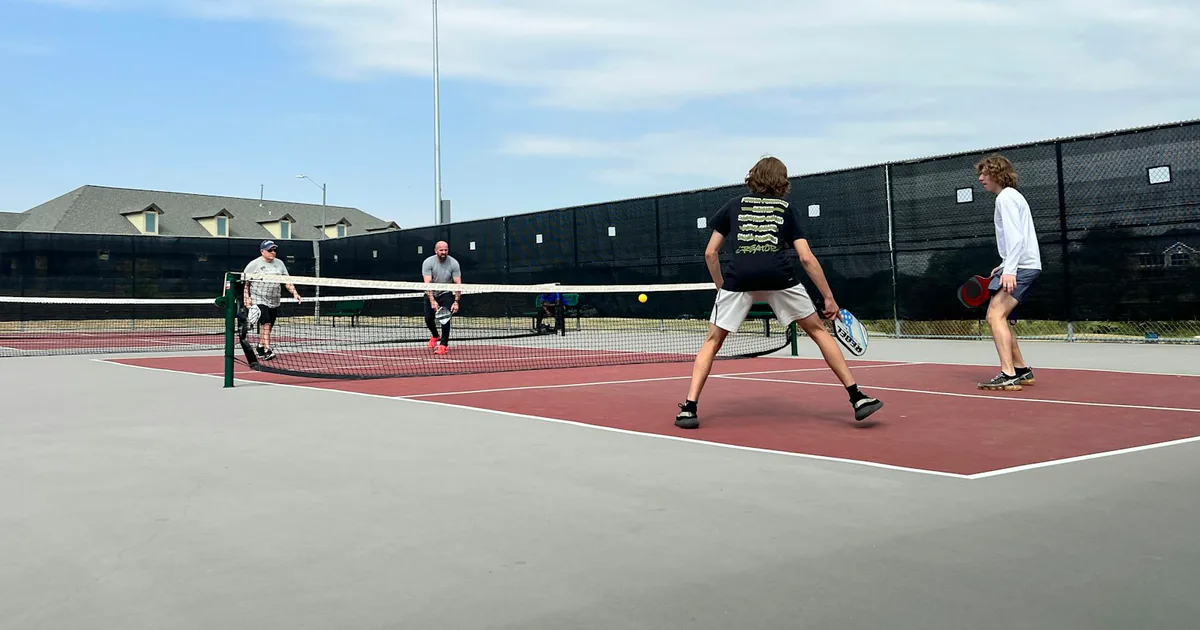
Pickleball looks simple: hit a plastic ball over a net and try not to launch it into the next county. Then someone calls out “0-0-2,” tells you to stay out of the kitchen, and suddenly it feels like you missed an orientation meeting.
Don’t worry. The pickleball rules for beginners are much easier than they sound. Once you understand the serve, the two-bounce rule, the kitchen, and basic scoring, you are ready to play.
Hero photo by Lesli Whitecotton on Unsplash.
Pickleball in 30 Seconds
Pickleball is played as singles or doubles on a 20-by-44-foot court. Players use solid paddles to send a perforated plastic ball over a low net. The goal is to keep the rally going until the other side commits a fault.
Most beginners play doubles because there is less court to cover and more time for teamwork, encouragement, and blaming your partner in a friendly manner.
For more information about the sport, its court, equipment, and history, visit USA Pickleball’s official guide to what pickleball is and how it is played.
Rule 1: Start With a Diagonal Serve
Every rally begins with a serve from behind the baseline. The ball must travel diagonally into the opponent’s service court and clear the kitchen, including the kitchen line.
With a traditional volley serve, the server swings upward, contacts the ball no higher than the waist, and keeps the paddle head below the highest part of the wrist at contact. A drop serve is also allowed: release the ball, let it bounce, and hit it after the bounce.
Beginners often find the drop serve easier. Just remember:
- Stand behind the baseline.
- Serve diagonally across the court.
- Aim beyond the kitchen line.
- You normally get one serve attempt.
Rule 2: Remember “Bounce, Bounce, Then Play”
The two-bounce rule is one of the most important basic pickleball rules.
After the serve:
- The receiving team must let the ball bounce before returning it.
- The serving team must also let the return bounce.
- After those two bounces—one on each side—either team may hit the ball in the air or after a bounce.
An easy memory trick is: serve, bounce, bounce, then anything goes—except, of course, the kitchen rule.
The two-bounce rule prevents players from charging the net immediately and smashing the first return. It gives both teams a better chance to settle into the rally.
Rule 3: Know What You Can Do in the Kitchen
The “kitchen” is the seven-foot non-volley zone on each side of the net. Despite the nickname, snacks are not required.
The most important kitchen rule is simple: you may not volley the ball while touching the kitchen or its boundary line. A volley means hitting the ball out of the air before it bounces.
You also commit a fault if your momentum carries you into the kitchen after a volley. That remains true even if the ball has already bounced twice or the rally appears to be over.
Here is the part many new players miss: you are allowed to enter the kitchen. You can step into it and hit a ball after it bounces. You simply cannot volley while touching the zone or its line.
In short:
- Ball bounced in the kitchen? Step in and hit it.
- Ball still in the air? Keep your feet—and your momentum—out.

Photo: USA Pickleball. Republishing permission must be confirmed.
Rule 4: Learn the Easy Version of Pickleball Scoring
In traditional side-out scoring, only the serving team can score a point. Most recreational games are played to 11, and the winner must lead by two points. Some tournament games go to 15 or 21, while certain formats use rally scoring, so confirm the format before starting.
Why Are Three Numbers Called in Doubles?
A doubles score has three numbers:
Serving team’s score – receiving team’s score – server number
For example, “4-2-1” means:
- The serving team has 4 points.
- The receiving team has 2 points.
- The team’s first server is serving.
Each player on a doubles team normally gets a turn to serve before a side out gives the ball to the opponents. The exception comes at the start of the game, when the opening team begins with its second server. That is why a new game starts at 0-0-2.
It sounds strange for about five minutes. Then you will start saying it with confidence and confusing the next beginner. The circle of pickleball continues.
Rule 5: Switch Sides After Scoring
The server begins from the right side of the court. When the serving team wins a point, the server switches to the left side and serves again. The server keeps alternating sides after every point scored.
In singles, the rule is especially easy:
- Serve from the right when your score is even.
- Serve from the left when your score is odd.
Remember: even is right.
Rule 6: Know the Most Common Faults
A fault ends the rally. Depending on who committed it, the result is either a point for the serving team or a loss of serve.
Common pickleball faults include:
- Serving outside the correct diagonal service court
- Hitting the ball into the net
- Hitting the ball out of bounds
- Volleying before the ball has bounced once on each side
- Volleying while touching the kitchen or its line
- Allowing the ball to bounce twice
- Touching the net while the ball is in play
- Being struck by the ball before it bounces out
- Violating the serving rules
Expect to make several of these mistakes during your first game. Everyone does. Laugh, learn, and play the next rally.
Rule 7: Lines Are Usually In
A ball touching a court line is generally considered in. The important exception occurs on the serve: the kitchen line is part of the non-volley zone, so a serve that lands on it is short and therefore a fault.
When making a line call, only call a ball out when you clearly see space between the ball and the line. When in doubt, give the benefit of the doubt to your opponent. Good sportsmanship keeps the game fun.
Your First-Game Pickleball Rules Checklist
Before the first serve, remember these seven things:
- Serve from behind the baseline and aim diagonally.
- Let the serve bounce.
- Let the return bounce too.
- Do not volley from the kitchen.
- In traditional scoring, only the serving team earns points.
- Games are usually played to 11, win by two.
- If you forget the score, ask—everyone else probably forgot too.
Frequently Asked Questions About Pickleball Rules
Can you step into the kitchen in pickleball?
Yes. You may stand in or enter the kitchen at any time, but you cannot volley while touching the kitchen or its lines. It is perfectly legal to enter the kitchen to hit a ball after it bounces.
Does the ball have to bounce in pickleball?
The serve must bounce before the receiving team returns it, and that return must bounce before the serving team hits it. After one bounce on each side, players may volley or play the ball after a bounce.
How many points are needed to win a pickleball game?
Most games are played to 11 points, and a team must win by two. Some tournament formats play to 15 or 21.
Can only the serving team score?
Under traditional side-out scoring, yes. Some leagues and events use rally scoring, where a point is awarded after every rally, so check the chosen format before play begins.
What does 0-0-2 mean in pickleball?
It is the starting score in a traditional doubles game. The first zero is the serving team’s score, the second is the receiving team’s score, and the two identifies the opening server as the second server for that service turn.
Is pickleball played as singles or doubles?
Both. Singles and doubles use the same court dimensions and most of the same basic rules, although doubles is more common and uses a three-number score.
Ready to Play?
You do not need to memorize the entire rulebook before stepping onto a court. Start with the serve, two bounces, the kitchen, and scoring. The rest becomes easier once you begin playing.
After learning the rules, consistent practice is the next step. Explore how an at-home pickleball training board can help you work on dinks, volleys, reactions, and accuracy between games.
This article is a beginner-friendly summary, not a substitute for the official rulebook. Rules and event formats may change; consult USA Pickleball for current competitive requirements.
Want Personalized Coaching?
Coach Pickle gives you an AI pickleball coach in your pocket. Get strategy advice, drills, and mental game coaching tailored to your skill level.